Training project · 2026 · FastAPI/LLM
AI Triage Service
First-line triage for support requests: category, draft reply, confidence and escalation.
47 tests
5 req/min
4 categories
FastAPI · Pydantic 2 · SQLite
OpenAI-compatible API · Docker · Caddy
Demo mode · fallback · audit
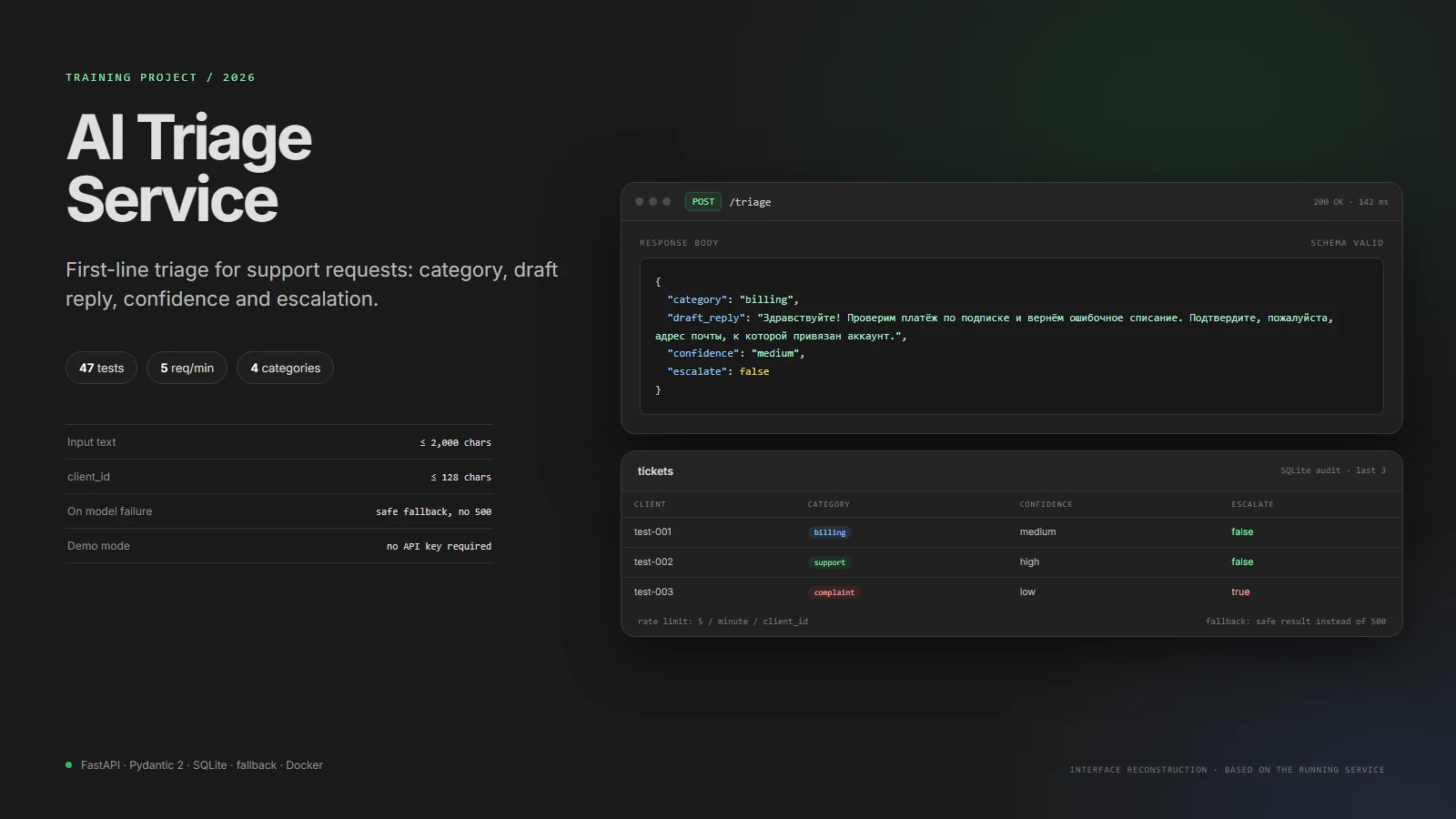
INTERFACE RECONSTRUCTION · BASED ON THE RUNNING SERVICE
Problem
Support teams spend time sorting repetitive messages and writing similar replies. Full automation is risky: a wrong answer costs more than a slow one. The service has to be useful when the model works and safe when it does not.
What it does
- Accepts a support message and classifies it as billing, support, complaint or other.
- Writes a draft reply for a human agent.
- Returns confidence and an explicit escalation flag.
- Stores every request and result in SQLite for audit.
- Limits each client to 5 requests per minute.
- Runs in demo mode without an API key using a local knowledge base.
How it works
- Request validation: text up to 2,000 characters, client ID up to 128.
- Per-client rate limit: 5 requests per minute.
- LLM call through an OpenAI-compatible endpoint.
- JSON parsing and schema validation.
- Audit record in SQLite.
- If the model fails, a fallback response is returned instead of a 500.
Engineering notes
- 47 tests, 4 categories, confidence, escalation.
- Rate limiting and input limits are part of the contract.
- Docker Compose with healthcheck and Caddy.
- SQLite audit trail.
- Demo mode works without a key.
What I would improve next
- Human feedback loop: correct the category and reuse the correction.
- CRM/helpdesk integration instead of a standalone endpoint.
- PII redaction before sending text to the model.
- Auth, per-tenant quotas and monitoring.
Interface reconstruction based on the running service. Not a live screenshot. The response card is a static representation of the JSON output.